English
  русский
  عربى
عربى 
The interior finishing materials market is witnessing steady growth in demand for skirting PS, a category that has evolved from a niche alternative into a mainstream specification for residential and light commercial projects. Skirting PS, a polymer-based skirting board with an expanded polystyrene core and a hardened surface layer, is increasingly valued for its moisture resistance, installation speed, and cost predictability. Market data indicates that polymer-based skirting products now account for approximately 18 percent of the interior trim segment in Asia-Pacific markets, with annual growth projected at 6.5 percent through 2028. The modern skirting PS product has matured significantly from its early iterations, and the factories producing it are being evaluated on manufacturing capability, material quality, and customization responsiveness.
How Do Factory Strength and Production Capacity Shape Market Confidence?
Manufacturing scale directly determines a factory's ability to meet project deadlines and maintain consistent quality. A dedicated skirting PS factory typically operates multiple co-extrusion lines, with mid-sized facilities running six to twelve lines capable of combined annual output between 3 million and 8 million linear meters. Capacity utilization rates above 80 percent generally indicate strong order books and stable workforce retention. Raw material management serves as another capability indicator, with factories maintaining 25 to 40 days of prime polystyrene resin inventory better positioned to avoid production interruptions during supply chain fluctuations. Modern high-output co-extrusion lines achieve speeds of 8 to 12 meters per minute for standard profiles. In-house mold fabrication capability allows a factory to develop new profile shapes within two to three weeks, compared to six to eight weeks when tooling is outsourced. Finished goods warehousing of 1,500 to 3,000 square meters enables factories to buffer production against fluctuating delivery schedules, a logistical advantage for project-based procurement.
What Material Properties and Core Advantages Define the Product?
The technical foundation of skirting PS lies in its composite structure, combining a lightweight polystyrene core with a high-density outer shell. The core material has a density of 60 to 90 kilograms per cubic meter, keeping product weight at approximately 0.9 to 1.2 kilograms per linear meter for a standard 120-millimeter height profile. The hardened surface layer achieves a density exceeding 280 grams per square meter on premium products, with impact resistance verified through falling-weight testing where high-grade boards withstand a 500-gram steel ball drop from 60 centimeters without permanent deformation. Moisture resistance stands as the defining advantage, with the closed-cell structure absorbing less than 0.5 percent water after 24 hours of full immersion, compared to 15 to 25 percent for medium-density fiberboard alternatives. This makes skirting PS suitable for coastal properties, basements, and bathrooms where humidity remains elevated. Dimensional stability testing shows expansion and contraction of less than 0.3 percent across temperatures from minus 10 to 50 degrees Celsius, eliminating seasonal gapping at joints. Premium products achieve 8H pencil hardness ratings, resisting scuffing from vacuum cleaners and casual footwear. Fire retardancy compliance with Class B1 standards is achieved through additives integrated at the raw material stage.
How Are Customization and Contract Manufacturing Services Evolving?
Customization has become a central offering of the skirting PS supply chain, with factories adapting specifications to diverse project requirements. Profile customization encompasses height variations from 60 to 200 millimeters, thickness options from 10 to 25 millimeters, and decorative surfaces replicating wood grain, stone texture, or solid colors. Digital printing at 1,200 dots per inch resolution enables wood grain reproduction visually close to natural timber. Color matching achieves a Delta E tolerance of 1.0 or lower, with digital records retained for future orders. Surface finishes span gloss, satin, and matte sheens for coordination with door frames and cabinetry. Contract manufacturing for building material distributors and retail chains represents a growing segment, with private-label packaging, branding, and barcoding customized to buyer specifications. small order quantities for fully customized profiles have declined to approximately 2,000 linear meters, lowering the barrier for boutique projects. Technical documentation packages including fire certificates and installation guidelines are provided in formats aligned with regional building code requirements.
Skirting PS has moved from a peripheral alternative into a defined product category with its own performance benchmarks and manufacturing standards. As construction practices prioritize moisture management, installation efficiency, and dimensional stability, the product's inherent material advantages align with market direction. The skirting PS factory that combines production reliability with surface engineering expertise and responsive customization stands to capture a growing share of interior finishing specifications.
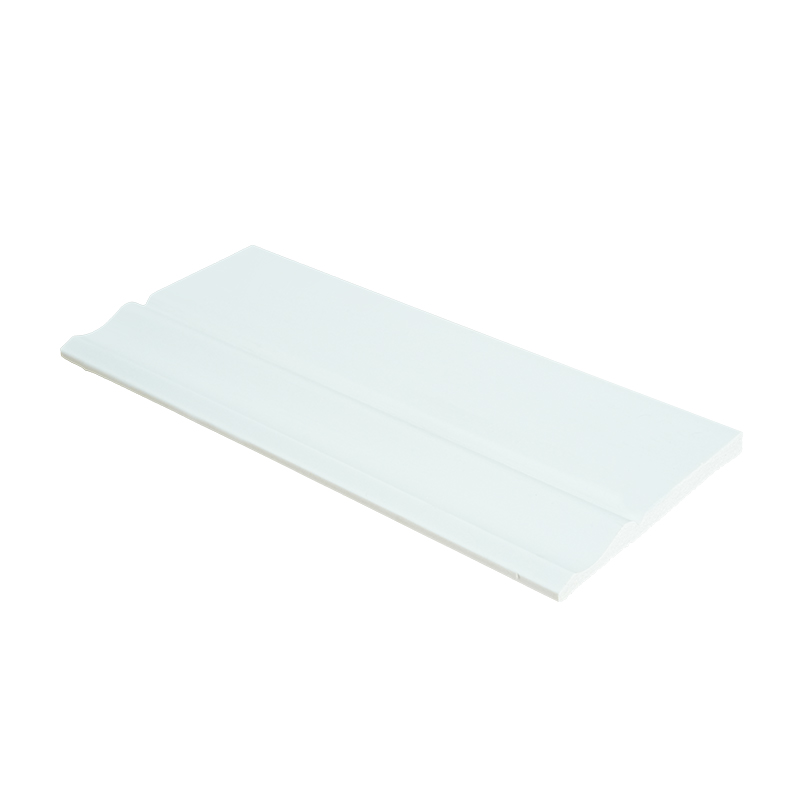
For a polished and bright interior finish, we recommend the Glossy White PS Skirting for Bright Room Accents from Haining Commerce Imp & Exp Co., Ltd. This polystyrene skirting board features a high-gloss white surface that reflects light beautifully, making rooms feel larger and more open. It is lightweight, easy to cut, and simple to install – no special tools required. The glossy finish resists scuffs, stains, and moisture, making it superb for living rooms, bedrooms, or modern commercial spaces. Unlike traditional MDF skirting, this PS material won't swell or warp over time. An ideal choice for accenting walls with a clean, contemporary edge. Choose Haining Commerce for style and durability.